


What we do
Protection that fits where you are.
Every engagement builds your own capability, not a dependence on us.
Our services
Four ways we work with you.
ESRM implementation progression
Eighteen tasks. One clear progression.
Security risks are identified and mitigated in the context of the objectives they affect. Then the cycle runs again, and the program matures with every turn.
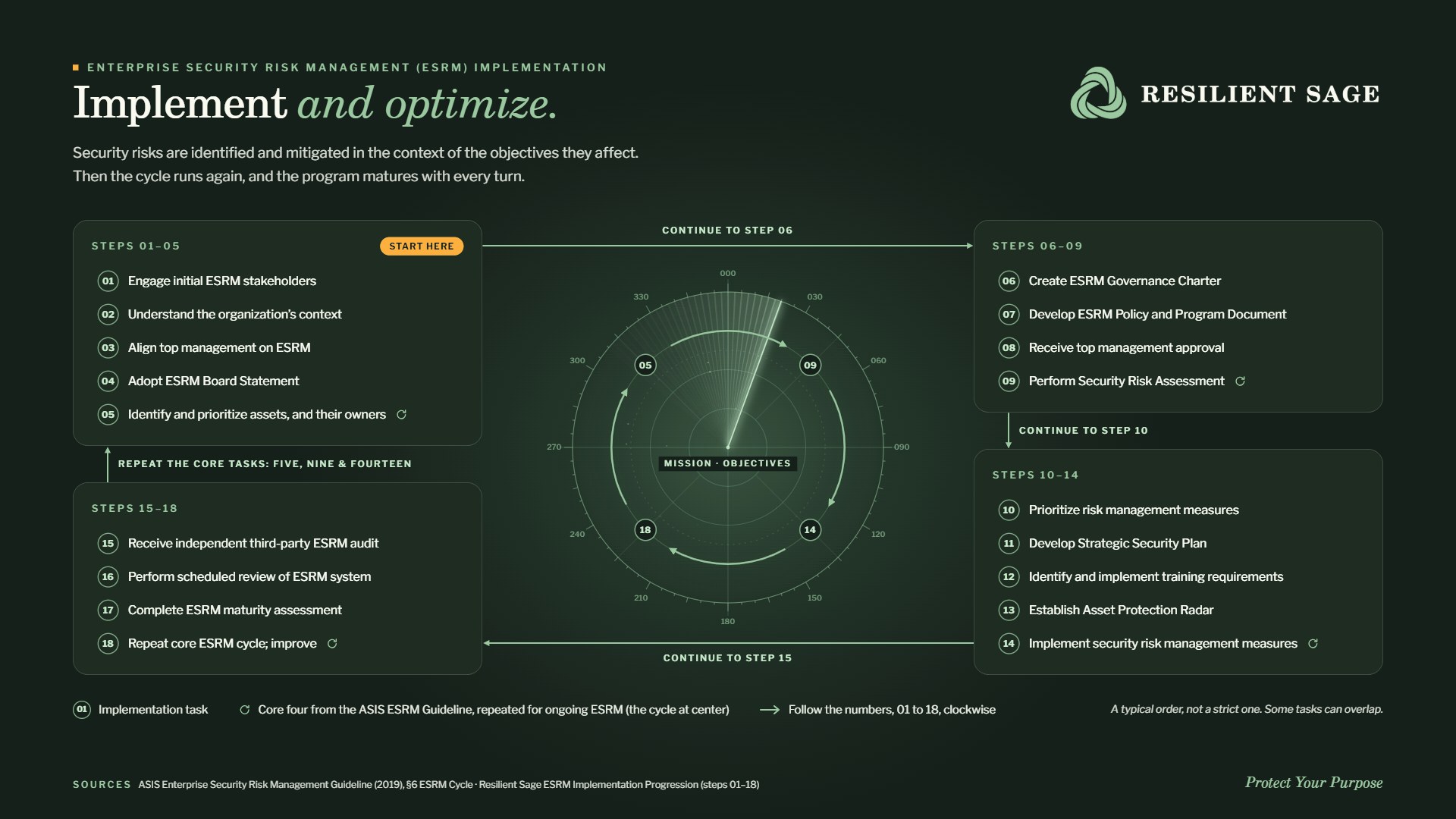
These eighteen tasks are the core of implementing Enterprise Security Risk Management (ESRM). They don't have to be done in exactly this order: it's a typical flow most organizations follow. Some tasks are simple; others are intensive.
The core four from the ASIS ESRM Guideline (2019), repeated for ongoing ESRM.
Download the progression (PDF)Steps 01–055 tasks
- 01
Engage initial ESRM stakeholders; establish participation and priorities
Brings preliminary leaders and strategy-setters into the effort from the start, so ESRM is built as a multidisciplinary partnership. ESRM is a team sport.
- 02
Understand the organization's context
Establishes how the organization's purpose, objectives, values, culture, operating environment, existing security and risk management capabilities shape what must be protected.
- 03
Align top management on ESRM
Secures board and executive support for ESRM's objectives and approach. ESRM ties directly into organizational objectives and strategy.
- 04
Adopt ESRM Board Statement
Documents top management's commitment to ESRM, giving the program its mandate and oversight, and defining periodic reporting requirements.
- 05
Identify and prioritize assets, and their owners
Determines what the organization relies on to achieve its objectives, who is accountable for each asset, and which assets warrant priority protection.
Steps 06–094 tasks
- 06
Create ESRM Governance Charter
Establishes the governing body and defined roles that direct day-to-day ESRM, set its goals and make top-level protective decisions.
- 07
Develop ESRM Policy and Program Document
Codifies the desired result and requirements of ESRM, and how ESRM is implemented and managed.
- 08
Receive top management approval for the charter, policy and program document
Gives the charter, policy and program document formal organizational authority, in accordance with the board statement.
- 09
Perform Security Risk Assessment
Identifies, analyzes and evaluates security risks to objectives against the organization's risk appetite and tolerance, to produce a prioritized risk picture for decision-makers.
Steps 10–145 tasks
- 10
Prioritize risk management measures
Using the Security Risk Assessment (SRA), each treatment and risk acceptance decision is placed with the asset owner who owns the risk, and recorded. Organizes initial sources for top management reporting.
- 11
Develop Strategic Security Plan
Turns the findings of the SRA into a resourced, sequenced plan in which every investment traces a specific risk against a specific objective. Informs operational and capital spending for security risk management.
- 12
Identify and implement training requirements
Equips asset owners and those responsible for ESRM with the knowledge and skills required.
- 13
Establish Asset Protection Radar
Creates a single source for the ESRM leader to oversee the status of security risk management efforts against organizational objectives.
- 14
Implement security risk management measures
Puts the required measures into operation and keeps them effective through scheduled and event-driven re-assessment, lessons learned, council oversight and reporting to top management.
Steps 15–184 tasks
- 15
Receive independent third-party ESRM audit
Provides objective verification that the program operates as documented and achieves its intended outcomes.
- 16
Perform scheduled review of ESRM system
Re-validates policies, procedures and practices each year, and sets the council's strategic agenda so the program stays aligned with current objectives, risks and compliance issues.
- 17
Complete ESRM maturity assessment
Measures the program's current maturity and identifies what is required to reach the next level.
- 18
Repeat core ESRM cycle; improve
Continual monitoring for improvement. Re-executes steps five, nine and fourteen on a set cadence, so protection keeps pace with changes to the organization's objectives, assets, risk environment and compliance requirements.
Sound familiar?
Usually, it starts when…
You're growing fast or opening a new location
Something happened, or almost did
An insurer, auditor or board asked
You're growing fast or opening a new location
Something happened, or almost did
An insurer, auditor or board asked
You're growing fast or opening a new location
Something happened, or almost did
An insurer, auditor or board asked
A new security hire needs a plan
There's a worry you can't shake
You know you should, but don't know where to start
A new security hire needs a plan
There's a worry you can't shake
You know you should, but don't know where to start
A new security hire needs a plan
There's a worry you can't shake
You know you should, but don't know where to start
Start the conversation
Let's talk about what you're protecting.
We don't charge for scoping, brainstorming or quoting. Let's start with what you need, by video call or phone.